


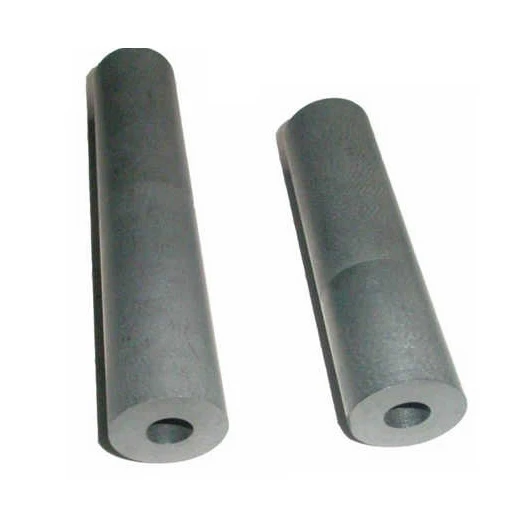
Graphite hot press dies are precision-machined tooling components used to contain, shape, and support materials during high-temperature pressing processes. Working alongside punches and auxiliary components under combined thermal and mechanical loads, these dies form parts to defined dimensional geometries.
We provide custom graphite machining services for industrial high-temperature tooling. Every hot press die set is manufactured according to customer engineering drawings, material specifications, and operational parameters.
Technical Specifications & Parameter Checklist
|
Specification Category |
Information Required for Quotation / Review |
|
Tooling Dimensions |
Outside diameter (OD), inside diameter (ID), overall height, and critical cavity features. |
|
Dimensional Tolerances |
Drawing-specified tolerances, geometric dimensioning and tolerancing (GD&T), and mating clearances. |
|
Graphite Grade |
Specified grade, minimum density, maximum ash content, or equivalent material requirements. |
|
Tooling Configuration |
Single-piece die, split die, punch set, sleeve, or complete assembly. |
|
Operating Conditions |
Maximum working temperature, applied force/pressure, pressing direction, and atmosphere (Vacuum/Argon/Air). |
|
Surface & Post-Processing |
Working-surface roughness (Ra), cleaning, or specialized treatment requirements. |
Typical Industrial Applications
Graphite hot press dies are engineered for powder-consolidation and high-temperature manufacturing processes:
Powder Metallurgy & Cemented Carbides: Forming hard metals, cemented carbides, and heavy alloy components requiring dimensional precision and wear resistance under load.
Advanced Technical Ceramics: Densification of engineering ceramics where material purity, strict temperature control, and precise cavity dimensions are critical.
Diamond Tools & Segment Manufacturing: Production of diamond-impregnated segments and specialized abrasive tools requiring repeatable thermal cycles and reliable part release.
Custom Graphite Hot Press Tooling Scope
Hot press tooling configurations vary according to press design, pressing direction, and part geometry. We supply individual components as well as matched tooling sets:
Graphite Dies
Define the mold cavity and contain the workpiece under applied pressure and temperature.
Graphite Punches
Transfer vertical or horizontal pressing force through the tooling assembly.
Graphite Sleeves and Inserts
Provide specialized guidance, alignment, or localized forming features.
Matched Tooling Assemblies
Integrated sets of dies, punches, and spacers machined with controlled running clearances for assembly.
Graphite Material Selection Factors
Tooling performance and service life depend on matching the graphite grade to the operating environment. Temperature alone does not determine material suitability.
When evaluating a graphite grade for hot pressing, consider:
Bulk Density and Microstructure: Influences material consistency, mechanical strength, and the achievable machined surface finish.
Mechanical Strength: Flexural and compressive strength must withstand applied loads and thermal stresses without premature cracking.
Thermal Properties: Thermal conductivity and coefficient of thermal expansion (CTE) dictate heating behavior and dimensional changes during thermal cycles.
Purity and Ash Content: High-purity grades are required when trace elements from the tooling could contaminate the processed material.
Machinability: Determines the precision of intricate cavity details, thin sections, and fine tolerances.
Operating Atmosphere: Air, vacuum, inert gas, or reducing atmospheres impose different oxidation and chemical compatibility limits.
Manufacturing, Precision Machining & Quality Traceability
Precision manufacturing and dimensional control are vital for preventing tooling failure and ensuring batch consistency. Our production workflow covers:
Engineering Review: Identifying critical functional dimensions, mating fits, thin sections, and potential stress concentrations prior to CNC programming.
Raw Material Verification: Verifying incoming graphite blocks against agreed density, purity, and structural standards.
Multi-Axis CNC Machining: Utilizing advanced milling and turning centers to achieve complex geometries, tight tolerances, and smooth cavity finishes.
Inspection & Quality Evidence: Measuring critical interfaces using calibrated tools. Dimensional inspection reports (DIR) and material certificates (CoC) can be supplied upon agreement.
Secure Protective Packaging: Tailored packaging designed for brittle graphite components, incorporating moisture barriers and impact-resistant cushioning for international transit.
FAQ
Q: Can you manufacture graphite hot press dies strictly to custom drawings?
A: Yes. All industrial graphite tooling is custom-machined according to customer drawings and specific technical requirements. Feasibility, achievable tolerances, and machining strategies are reviewed prior to order confirmation.
Q: What dimensional tolerances can be achieved?
A: Achievable tolerances depend on the graphite grade, component size, geometry complexity, and machining method. Please highlight critical dimensions on your drawing so our machining team can verify capability during the quoting stage.
Q: How can premature die cracking or excessive wear be minimized?
A: Tooling failure is often related to combined stress concentrations, improper thermal cycling, grade mismatch, or alignment issues during setup. Sharing failure analysis or operating history helps our engineers optimize the tooling design or material grade for subsequent orders.
Q: What documents can be supplied with the shipment?
A: Depending on project agreements, documentation can include material test reports (showing density, ash content/purity), dimensional inspection sheets, and batch traceability markings.
Hot Tags: graphite hot press dies, China graphite hot press dies manufacturers, suppliers, graphite for electric vehicle, graphite for energy, graphite molds, graphite seals, industrial graphite products, machined graphite products